Friday, 10 September 2010

Tom Petty and the untold story of rock-and-roll


"I was always struck by how many great rock musicians lost their mothers when they were very young. That would be Lennon and McCartney, the guys in U2, Madonna, Jimi Hendrix, Aretha Franklin, Sinéad O'Connor. It becomes an incredible list...if you look for it," says MTV executive Bill Flanagan.


"And I said that to Bono once - both he and Larry Mullen of U2 lost their mothers when they were kids - and he (Bono) said, 'It seems like the untold story of rock-and-roll is either your mother died or your father hated you...And, if like me, you were lucky enough to have both, there's no limit to what you can accomplish!'"

Listen to the audio clip (The Untold Story...), you'll hear rock legend Tom Petty explain how his fraught relationship with his father and his mother's premature death ignited his ambition, creativity and rage. "Those two factors, the dangerous shadowy figure of a dad and the sweet mum who left too early in your life, gives you a certain drive," says Petty (above photo).

"...There was an extreme rage in me that from time to time would show it's head...Any sort of injustice just outraged me. I just couldn't contain myself," adds Petty. 

"And this comes from my Dad just being so incredibly verbally abusive to me. He was certainly physically abusive at times and would give me pretty good beatings."

Flanagan says "some kind of anger...beyond normal teenage rebellion", like "a rocket fuel", draws artists like Petty into taking stands in adulthood against malevolent forces. Petty built his band's worldwide fan-base over 35 years with great songs and musics but also by famously refusing to make the normal compromises many artists make to get ahead. 


One giant record company tried to grab Petty's publishing rights to his songs. Another sought to exploit the growing popularity of Tom Petty and the Heartbreakers by raising record prices across the board. 


Petty strenuously fought both record companies, telling them "Look, I will sell fucking peanuts before I give in to you." The music business gasped collectively when both record companies eventually caved.  Both record companies finally realised Petty was  never going to back down.

Audio extract - The Untold Story of Rock-and-Roll - clipped from the inventively crafted epic documentary, Runnin' Down A Dream, Tom Petty and the Heartbreakers, directed by Peter Bogdanovich, 2007 (240 minutes).


Photo: courtesy of Billboard


Paul Coleman, London, September 2010

Saturday, 4 September 2010

England see some light at Wembley


Please forgive me. I couldn't resist this September sunset over London last night, especially as it cast a fierce flaming light on Wembley Stadium's famous bronze statue of Bobby Moore, England's great football captain, and one of my boyhood heroes.

Wembley's vast stadium bowl easily swallowed 73,246 souls eagerly anticipating England's European Championship qualifier against Bulgaria. The relaxed and good humoured Friday night crowd warmly greeted soldiers from the Household Calvalry, Parachute Regiment and the Royal Horse Artillery who paraded the English and Bulgarian flags before kick-off. All of the soldiers are due to be deployed in Afghanistan soon.


After politely booing the Bulgarian national anthem, the nerves of England's long-suffering fans were settled by an early Jermaine Defoe goal. As the first half match action on Wembley's green expanse dwindled, the livelier western end crowd kicked off a series of Mexican waves.


England's confident new goalkeeper Joe Hart laughed off one hairy moment when team-mate Glen Johnson, trying to sweep a cross safely behind for a corner, clumsily deflected the ball towards Hart's far post. Fortunately, Hart plunged smartly down to clutch the ball before it crossed the line, depriving Johnson of an embarassing own goal. Hart stood up, the ball safely cradled in his arms, and chuckled at a much relieved Johnson. The old adage says 'goalkeepers must be crazy'. Hart brings his own brand of cheeky lunacy to England's goalmouth. Early days, of course, but Hart could become a cult hero.


Further Hart saves helped England defence survive some shaky second half moments before Defoe's third goal sealed a 4-0 win. Defoe's hat-trick earned him the match ball and sparked memories of Jimmy Greaves in his goal-scoring heydays in the 1960s. Wayne Rooney unselfishly prompted Defoe from midfield, an interesting role for Rooney reminiscent of Paul Gascoigne in Gazza's 1990s pomp.


To their credit, Bulgaria's bellowing fans, boys and girls, coralled in the south-eastern section, continuously hollered macho support for their team but their 'ov' team - including Angelov, Ivanov, two Petrovs and a Popov - suffered an 'off' night. A weary Zhivko Milanov unceremoniously chinned England's James Milner close to the corner flag.


After the final whistle, happy kids ran shrieking through illuminated fountains outside the Wembley Arena, watched by contented mums and dads. With no work and no school tomorrow, there was little need for that mad rush to pack the tube trains and tuck the kids in bed. Pubs, kebab shops and Indian restaurants around Wembley Park station enjoyed a roaring trade.


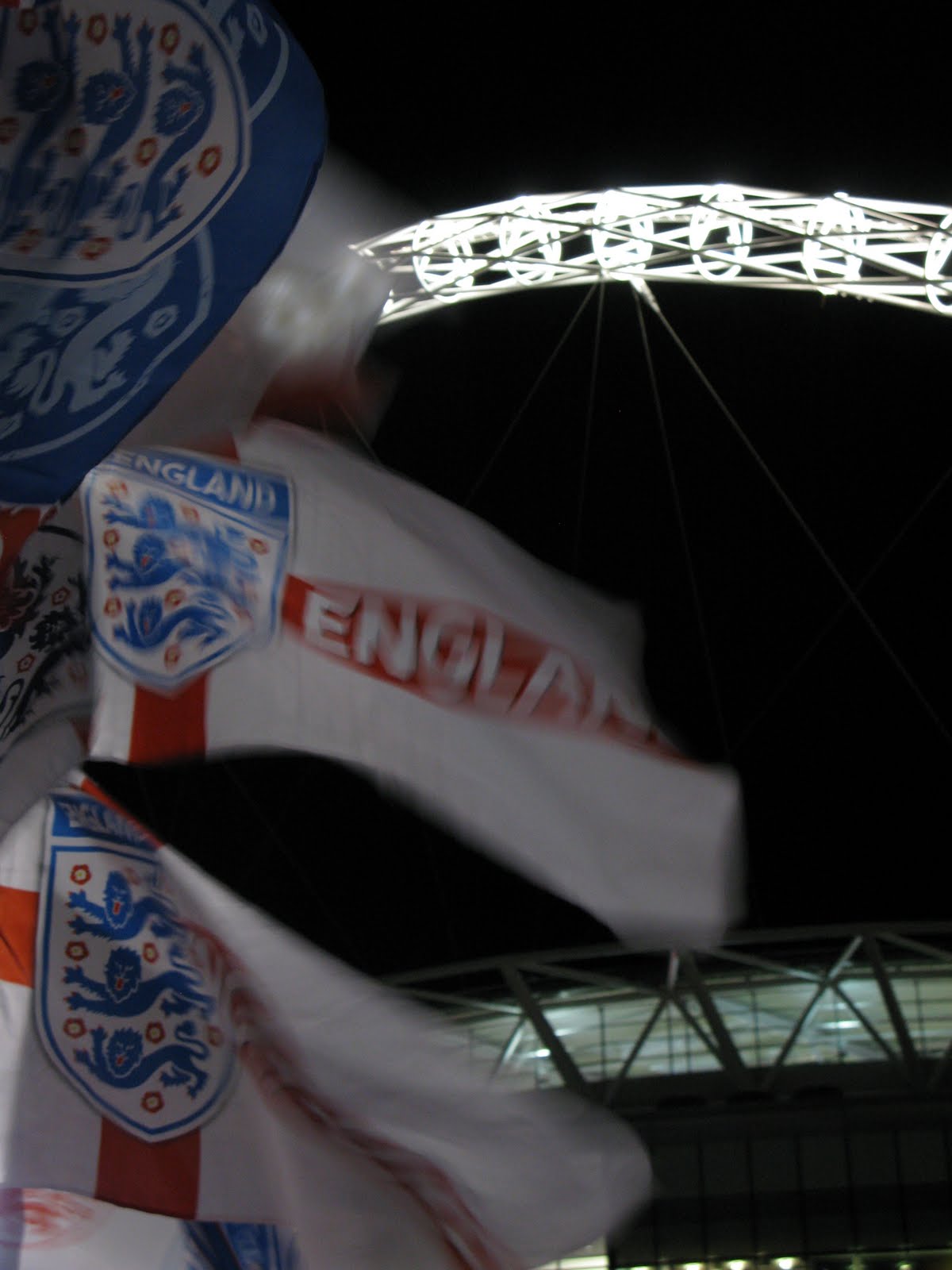
Flags bearing the Three Lions crests flapped happily too. England's breeze had blown away Bulgaria's mild threat - and Wembley Stadium's famous arch lit up London's skyline. Perhaps, somewhere, Bobby Moore was smiling too.

Photos: Paul Coleman
(Click on images to enlarge)

Paul Coleman, London, September 2010.

Sunday, 15 August 2010

Postscript: Survivors of the sinking of the Andalucia Star

I am grateful to Caroline Brechin for contacting me with news of more survivors of the sinking of the Andalucia Star by a German U-Boat in October 1942.

Caroline says: "My great uncle,Robert Cruickshank, his wife and child, Dolly Baxendale and Jacquelyn Cruickshank,were on board this ship, He had emigrated from Aberdeen Scotland and volunteered in Buenes Aires. All three survived."


Paul Coleman, London, August 2010.


Sunday, 8 August 2010

The Andalucia Star: a survivor's tale, part 3


My previous posting expressed my gratitude to Michael (Miguel) Webb. He'd sent me his his father Gordon's eyewitness account of the German U-Boat attack that sank the Andalucia Star


Below, the second part of Gordon F. Webb's letter to his parents (Michael's grandparents) of 1 November 1942, recalls how survivors bobbed around in lifeboats after the Atlantic Ocean had swallowed the sinking Andalucia off the West African coast. They didn't yet know HMS Petunia was coming to their rescue.

Gordon Webb wrote:

"We began rowing and tried to contact other lifeboats. We came across a raft with five men. As the boat was full, we towed the raft.

"Later we saw another lifeboat, Number 2, which was oarless, having capsized. So, the men in the raft were transferred to that boat, leaving only the boats carpenter on the raft as he was near dying. 

"We came across another raft with four men who were also transferred to the towed boat.

"Having swallowed a lot of water, I was sick, but felt better after it. Nearly everybody was sick, either with the movement or the salt water.

"When dawn broke, six of the lifeboats were within sight of each other so we made a rendezvous, and having distributed the passengers better  among the boats we set a course for land, about 200 miles away to the E.N.E.

"The day turned out overcast and it rained almost all day, being very fresh for the tropics. We all set sail except boat Number 2 (who had lost all the equipment), which we towed. The wind was SW, so we were fortunate as it took us toward land.

"Our boat was moderately cheerful and almost all the passengers and crew co-operated, but it was hard to sleep and very uncomfortable to sit in one position the whole time.

"Nothing was sighted all day, but we were reasonably certain that the following day something would turn up, so there was no anxiety. I took turn at the tiller from 1930 to 2130 and then slept well till 2.30. 

"I was quite enjoying the adventure by then as it was very much like sailing on the River Plate, only that the boat was rather crowded. At 3.45 whilst talking to the man at the tiller he sighted a shadow that turned out to be our rescuers HMS Petunia. We werent long at being picked up and made comfortable on the Petunia in the traditional Navy fashion.

"After searching for a few hours the remaining boats were picked up and to everyones relief there was a minimal loss of lives - 4 people, 2 from boat Number 2 that capsized. Chips who died on the raft with heart trouble, and Hayes, a volunteer.

"We arrived at Freetown at 2030 on Thursday with no clothes except the rags we stood in. Some lost money and documents. The work of the authorities here has been stupendous, and we are being looked after very well." 

***

(My grandfather Leslie Coleman, a ship's chief steward, sailed frequently on the Andalucia Star before World War II. He was saddened by the loss of three crew members and a passenger and the sinking of one his favourite ships).

Paul Coleman, London, August 2010

Tuesday, 3 August 2010

The Andalucia Star: a survivor's tale, part 2


Yesterday's posting expressed my gratitude to Michael (Miguel) Webb. He'd sent me his his father Gordon's eyewitness account of the German U-Boat attack that sunk the Andalucia Star

Gordon F. Webb's letter to his parents (Michael's grandparents) of 1 November 1942, recalled the moment he thought he was going to die. Gordon Webb wrote:

"On Tuesday, 6th October, 1942, I was on board the Andalucía Star about 200 miles from Freetown. My watch on the bridge started at 20.00 so I sat down to dinner at 1920 with Wesley, my cabin companion. At 2100 we had not seen anything worth mentioning during our hour of watch.

"I handed my post over to Rudkin and went down to a concert being held in the lounge. The concert ended at 2140. I looked for Alan Cooper in the smoking room but did not find him there.

"I went to my cabin, meeting Wesley on the way. Just before entering our cabin at 2150, the first torpedo struck the ship on the portside, just aft of the smoking room, followed by a second torpedo almost at the same time and place.

"My first impression was of surprise, and I thought that it couldnt be true. Wesley and I immediately rushed to the cabin. A few seconds after being hit, the lights flickered and then went out.

"I put on my life jacket, picked up my emergency bag and raincoat, and walked up the passage to the lounge. On my way there I heard Mrs Cruickshank crying that her husband was trapped, so I tried to batter down the door; but a few seconds later he walked out with their child. The place I had been battering was the cabin wall.

"I passed through the lounge on deck and down to the main deck by the portside door, as the starboard door was jammed. By this time the ship was righted again but was sinking by the stern. My most vivid impression was of the sickening smell of the cordite from the torpedoes.

"I crossed the deck to the starboard side to our lifeboat Number 1 - and waited there till we were told to board it. Once we were in, the boat was slowly lowered till we touched the water; then the falls were let loose.

"Fortunately the sea was calm and the rest of the passengers and crew were slowly lowering themselves into the boat which was riding in the water still attached to the painter.

"It was 2210 and the Andalucía Star was slowly settling in the stern when the third torpedo struck the starboard side, just ten yards in front of us.

"I thought my last moment had come when the lifeboat heaved out of the water and nearly turned over. The explosion raised a big column of water that came roaring down on us, mixed with meat and cork from the refrigerating chamber where the torpedo had struck.

"Our boat was half filled with water, but still floating when we loosened the painter and started rowing away from the sinking ship. We rowed away astern of the Andalucía Star, and then round to the portside where we waited till the ship sank.

"She slowly turned over on the portside and her stern disappeared under the water until her bows were the only thing showing. 

"All traces of the Andalucía Star were gone at 2240."  

(More to follow in my next post...Part 3).


(My grandfather Leslie Coleman, a ship's chief steward, sailed frequently on the Andalucia before World War II. He was saddened by the loss of three crew members and a passenger and the sinking of one his favourite ships).

Paul Coleman, London, August 2010

Sunday, 1 August 2010

The Andalucia Star: a survivor's tale (Part I of 3)


Once again, I am the astonished yet grateful recipient of another remarkable survivor's tale from the sinking of the SS Andalucia Star during World War II.


The Andalucia was cruelly hit and sunk by three torpedoes fired from U-107, a German U-Boat submarine on 6 October 1942. (Click on link to see Wallace Trickett's painting of the attack).


I am now indebted to Michael (Miguel) Webb, a pediatrician working in Comodoro Rivadavia in southern Argentina, who has emailed me a letter he found only recently, written by his father, Gordon F. Webb. The letter, dated 1st November, 1942, written by Gordon to his parents, vividly recalls how he survived the U-Boat attack and witnessed the Andalucia Starfinal moments.


Gordon Webb's letter merits its own space, so my next two postings will feature his eye-witness account in full. Just to remind you, the background to all of this is that my own dear grandfather Les (pictured below) had sailed across the Atlantic many times on board the Andalucia Star before World War II. Naturally, Les was very upset when he learnt the 15,000-ton Blue Star refrigerated passenger, cargo and mail liner - one of his favourite merchant navy ships - had been torpedoed and sunk.

You might also recall how the life of a little girl, aged five, was saved by the bravery of  stewardess Mrs L.A. Green and crewman William Wheeler. Green had switched on a red light on the little girl's lifejacket before lifting her into a lifeboat. Minutes later, the lifeboat dropped as it was lowered and tipped Green and presumably the little girl into the Atlantic waters.
Green was killed but the little girl was fortunate. William Wheeler, hearing the little girl's cries, saw the red light and swam to save her. Incredibly, shortly after I posted this tale, I received an email from Jill McNichol-Harrell(née Bicheno) that simply began: "I was the little girl."


Michael Webb tells me Gordon, his father, spoke very little about the war. But I do know he was in the Royal Air Force, flying as a navigator in Sunderland flying boats, says Michael. He was based in Lanark till he was grounded due to ear trouble.


Remarkably, it was a Sunderland that sunk U-107, adds Michael. I wonder if there is any way of finding out where the avenging Sunderland was based?

Michael adds the Andalucia Stars Argentine flag was recovered with the passengers names on it. For many years it was shown in the Luján History Museum. 

So, Gordon Webb's dramatic and poignant letter, written less than one month after the U-Boat attack, is featured in my next two postings, The Andalucia Star; a survivor's tale, Parts 2 and 3.


(Pictured: Leslie Richard Coleman, my grandfather Les)


Paul Coleman, London, August 2010.


Monday, 26 July 2010

Alex Higgins: compulsive practicer, unforgettable champion

The journalist Bill Borrows once asked the great world snooker champion Alex Higgins if he had enjoyed his life. 

"I haven't really had all that much to do with my life," said Higgins. "All I've done is take part in it."
Many sincere - and some grudging tributes - have been paid to Higgins following his passing away, aged 61, in his Belfast hometown last Saturday. The BBC's clips reflect Alex's achievements and personality but, of all the tributes, I prefer Jim White's astonishing February 2010  video interview with Higgins and his final take on the 'Hurricane' in a Daily Telegraph article.
Alex 'Hurricane' Higgins, the most natural, charismatic and mesmeric player to have lifted a cue, once fired a 118 tournament break in two minutes and four seconds. In the film interview, White asks Higgins to explain his phenomenal speed at clearing balls from a snooker table.


"I was a compulsive practicer," replies Higgins. "I used to experiment with various shots, like a golfer on a driving range using different clubs."
His greatest achievement? "When my daughter was born, when I was 32," says Higgins. "I felt I'd become a man."
And his greatest snooker feat? Higgins replies: "It's alright winning but you can take a lot of pleasure out of how you behave when you lose...That's the thing about being a good sportsman."


Even when Higgins' playing powers declined, his clashes with snooker's stuffy establishment and puffed-up referees revealed his mental agility and quick-witted  intelligence. In a 1995 World Championship qualifier Higgins had already compiled a 110 break when he asked the senior and snooty referee John Williams to move out of his way. 
Williams, standing behind Higgins, said huffily: "But I'm not in your line of sight."
To which Higgins replied: "No, you're in my line of thought."


Clearly upset with Williams, Higgins still instinctively cleared the colours to complete a memorable 137 break. But what about "No, you're in my line of thought"; that's a poetical putdown, isn't it?
Even Sir Winston Churchill, the putdown king, might've chuckled at that one.
Paul Coleman, London, July 2010.