Thursday, 13 May 2010

Newest London railway runs through world's oldest tunnel


“We’re now standing above the oldest tunnel in the oldest metro system in the world,” says Robert Hulse, director of the Brunel Museum in Rotherhithe. “Do you hear the train now travelling under our feet?”


Hulse and a group of Californian tourists (see above photos) were standing on a false ceiling laid inside the vast Rotherhithe entrance shaft of engineer Marc Brunel’s Thames Tunnel. Built between 1823-1843, the tunnel runs 4.3m (14ft) beneath the river bed between Rotherhithe on the south bank and Wapping on the north.


The train rumbling beneath was a Class 378, one of an impressive new fleet of 20 undergoing testing before the newly extended East London Line Phase 1 opens for full public service on May 23. Transport for London begins running a 12-train per hour service from that day between Dalston Junction in Hackney and three south London terminals - New Cross, Crystal Palace and West Croydon. The new railway runs north-south through east and south-east London, improving access to London’s rail and tube network for residents of Islington, Hackney, Tower Hamlets, Southwark, Lewisham and Croydon. 


The ELL boasts faster, more direct services and cheaper fares. Thousands of people in residential neighbourhoods such as Brockley, Forest Hill, Sydenham and Croydon will be within 45 minutes of their City workplaces. TfL describe Shoreditch High Street station as a ‘new London terminus’ as it sits just a few minutes walk from Bank, Liverpool Street, Bishopsgate, Spitalfields and Brick Lane. Trains pass through the 'station’, but you can see what TfL mean with its 'terminus' accolade.


The ELL offers an interchange with the Jubilee Line at Canada Water, allowing commuters from south-east London to reach Canary Wharf, the Docklands, Stratford, Stratford City and the Olympic Park. From January 2011, the ELL will run north to Highbury & Islington where passengers can connect to the Victoria Line, North London Line and other mainline services heading north of Finsbury Park. 


East London Line Phase II, given the green light by Mayor Boris Johnson last year, will provide an extension from Surrey Quays over the South London Line to Clapham Junction via Peckham Rye and Wandsworth Road. This section is planned to open in 2012 before the Olympics running four trains per hour – and it's this section that will give London Overground’s map an orbital look. 


The East London Line is new in many respects – new trains, stations, depots and tracks, new passenger markets and the first line to exclusively use GSM-R radio communication between signallers and drivers. The ELL is also the first time that TfL, as an infrastructure owner, has presided over the construction, management and maintenance of a newly built railway. 


Hence, it’s poignant the ELL connects Wapping and Rotherhithe under the Thames by using Brunel’s 366m (400 yards) Thames Tunnel, believed to be the world’s first ever tunnel built beneath an expanse of water. Sadly, neither Marc Brunel nor his son, Isambard Kingdom, lived to see the day in December 1869 when their tunnel became one of the first to be used for a railway when the original East London Railway opened for public traffic.


Some things aren't new. London's beloved mayor, the Conservative Boris Johnson, and his Labour predecessor Ken Livingstone, arranged separate photo-shoots in April and May where they each claimed credit for the £1 billion project that includes Phase II and the Thames Tunnel's renovation. In fact, a lot of credit - literally - belongs to the European Investment Bank that underpinned the once struggling project with a £450m loan in 2005. But let's give Boris and Ken their due - they both backed the ELL to the hilt. 


However, if any individual deserves credit for driving the ELL forward, my vote goes to Ian Brown, TfL's experienced and enthusiastic London Rail director.Brown (see above photo) and his team confidently predict 33 million journeys will be made on the ELL in 2011 at the rate of 100,000 per day, rising to 120,000 per day and 40m annually by 2016.  

Whatever happens, I think Brunel would've been proud that Brown and his TfL colleagues have put the Thames Tunnel (illustrated below) to such good use for the benefit of Londoners.


Click on images to enlarge.

Paul Coleman, London, May 2010.

Sunday, 9 May 2010

Bozza puts Gordon, Dave, Nick and Ken in the shade


Gordon, devoid of credibility and popularity, crept back to Downing Street after the election and squatted inside Number 10. His arch rivals David and Nick busied themselves in their secret 'coalition-building' meeting around the corner at Admiralty Arch. 

Meanwhile, back at his City Hall ranch, our beloved mayor Boris took advantage of the power vacuum and the media's distracted attention. Neither the Prime Minister nor the Tory leader were watching Bozza as he slipped out an announcement that Transport for London was going to buy Tube Lines, the ailing Private Public Partnership (PPP) set up by Gordon to upgrade London's creaking and overcrowded Jubilee, Northern and Piccadilly Lines. 

Boris promises Londoners that TfL 'will complete the delayed Jubilee Line upgrade quickly, ending the horrendous inconvenience of weekend line closures. Boris promises that upgrading of the Northern - infamously tagged the 'misery line' - will also be completed without the vast amount of weekend line shutdowns that Tube Lines, a consortium of Ferrovial and Bechtel, had requested. Boris promises that new, faster and more frequent trains will arrive sooner 'in-house' with TfL rather than later and late with Tube Lines.


In this sense, it's BoZo and not his rival David who has removed the PPP, one of the most unpopular legacies of Gordon's reign. Ken, Boris' predecessor as mayor, had tried to KO Gordon's PPP in the courts but failed. BoJo is now bagging the political house points.


Boris, possibly rightly, thinks this move will raise his own popularity; but the bigger question remains - how can TfL afford the £310 million price tag for Tube Lines' shares, owned by Ferrovial and Bechtel? Can TfL find the money through efficiencies and savings achieved during the upgrades themselves? 

Might Boris and TfL at some point have to squeeze the money from other parts of TfL's budget? It's a budget already being squeezed. Boris and TfL's board are already implementing a business plan designed to save more than £5 billion up to 2017/18. 

True, Boris' decision to buy Tube Lines has put Gordon, Dave, Nick and Ken in the shade. But will Boris end up robbing Peter to pay for Paul?


Paul Coleman, London, May 2010

Photo: London Underground's Westminster station (courtesy TfL 2005)

Wednesday, 28 April 2010

Up on the roof


We met beside the statue of Paddington, the cuddly fictional bear who kept marmalade sandwiches in his hat and who was named after Isambard Kingdom Brunel's famous London station. 

Minutes later, clustered in a tiny room in a construction site portakabin, we were all sporting steel toe cap boots, safety gloves and goggles, garish orange high viz one-piece overalls, and hard hats - minus the marmalade sandwiches.

"The safety goggles are Gucci, so guys you look good," chippered Richard Wadkin, safety chief for Morgan Est, one of the contractors restoring Paddington Station's Edwardian Span 4 roof. "It'll be noisy up there. The guys in the roof are grit blasting and needle gunning the metal. Don't worry, St. Mary's Hospital is just down the road."

Refurbishing the Span 4 roof is an impressive way for Network Rail to blast £35 million. Since Span 4 was completed in 1916, it's a London roof that has withstood the test of time - and survived the worst the Luftwaffe could rain down during World War II .


Span 4 is the Grade 1-listed section of roof that covers platforms 9-12 inside Paddington's eastern extension. The original three spans of Brunel's Paddington were completed in 1854.


Paul Futter, Network Rail's top bod on the project, speaking to us on the temporary 'crash deck' built to protect passengers from the roof's ancient glass and metal, explained how new glass and repaired rib arches will allow passengers on the platforms below to bathe in natural light - similar to the Eurostar folks at St Pancras International.


The restoration of the 200-metre long roof should be complete by Christmas. Some 70% of the roof has been stripped already of the old glass and cladding leaving behind the ribs, several salmon red with rust and some in need of very careful repair. Meanwhile, below passenger buy their doughnuts and coffees and board their trains blissfully unaware of the orange army toiling above them.


Futter said Network Rail and its contractors - Morgan Est and Morgan Ashurst - have got to get a move on because Crossrail wants to get started on building its new station on Paddington's western side. Crossrail want to shift the cabbies and their taxi rank on that side over to the east close to platforms 9-12; but, until Span 4 is done, the cabbies can't be moved and Crossrail can't really get going on its Paddington interchange.


At the moment there's a long way to go before Span 4 can be compared with St Pancras International's glittering roof; and even when Network Rail sign off Span 4, diesel fumes and smoke will begin smearing Paddington's new addition. "This will be an ongoing problem until electrification," stated a Network Rail briefing paper left amid the tea mugs on a table in the portakabin. 


(Click on images to enlarge).

Paul Coleman, London, April 2010.


Monday, 8 March 2010

Fly far, fly into Spring


On Friday afternoon (5 March), I thought the hibernating male Peacock butterfly, that other little life form in my study, had fluttered his final flutter. He stood still, wings up and closed, with no sign of movement or life. Gently, very gently, I dabbed his wings with the rubber end of a pencil. No movement, no trace, still as still can be. 


I felt a right berk. I hadn't rescued him from the biting early February wind, frost and snow to cause him to lamely die indoors. I felt I'd deprived him of Nature's glory and Nature of his glory.

To my relief, it turned out, he's a tough little guy. Moments later, he yawned open his wings (below), revealing those sumptuous markings. He raised my spirits further by clambering onto a paper towel soaked with a mix of lukewarm water and diluted Demerara sugar and honey. Unfurling his proboscis feeding tube, he began sucking up the mixture voraciously.


Still worried, I sought wiser advice and decided the best plan was to give him a halfway house option, to offer him shelter but with an open portal if he felt inclined to chance his luck.

Later, encouraged by flaring March sunshine, he sunbathed on an exposed warm brick wall, absorbing the energy like a Formula 1 racing car re-fuelling in the pits. Looking at him upside down, I noticed how the circles on his hind wings look like menacing eyes and how his body might look like a beak to a bird or a mouse. A great design for scaring off predators.

Watched curiously by next door's moggy (below), the Peacock (top photo) suddenly fluttered off the wall, circled quickly around me, and flew energetically into an azure blue sky and out of view, out of my life, into Spring. 


I'd enjoyed his company, had learnt a little about his world and it'd dawned on me that, in some ways, his plight was a bit of a metaphor for my own life. 

Fly far, little guy, fly strong.

Thanks to Peter Eeles for information and Amrit ;-) for sound advice.


Paul Coleman, London, March 2010

Saturday, 6 March 2010

Decisions we take, ripples we make


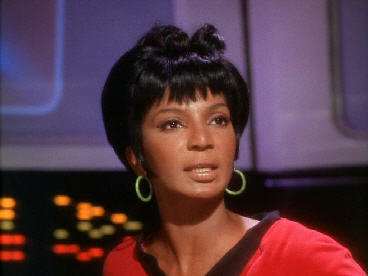
In 1966 Gene Roddenberry cast Nichelle Nichols as Lieutenant Uhura (above) in a new TV series called Star Trek. Roddenberry wanted Nichol's Uhura character to represent his ardent belief that women - and women of all colours - should play heroic, leadership roles in humanity's future, especially in space exploration. 

However, only the intervention of civil rights leader Dr. Martin Luther King persuaded a disenchanted Nichols, who had set her career sights on Broadway, to stay with Star Trek after a first season where advert breaks largely diminished Uhura's role. "You have the first non-stereotypical role in television, in a major TV series of importance," King told Nichols.


"Dr King raised my consciousness. I realised that what I do has an impact on other people's lives," said Nichols in an interview I conducted with the star (below) at her Californian home in 1992. "Every drop in an ocean has a ripple effect. I'm proud people saw me in the 23rd Century and that this changed their lives. 


"One young woman, who was a child then, wanted to be Uhura's daughter. The young woman turned on the TV one day, looked at me, and said,'My God, we are there! We're in the 23rd Century. I can be anything I want to be.' And she did; she became a superstar. Her name is Whoopi Goldberg." (below)


NASA (the National Aeronautics and Space Administration) employed Nichols to recruit astronaut candidates during the 1970s and 1980s. One young student, so inspired by Nichols but too young to apply, directed her studies towards qualifying for NASA's astronaut training programme. Nichols recalled: "She believed me when I said 'you can do it, you can fly, you can go into space and be anything you want to be'. Her name is Mae Jemison."


Jemison (above) became the first African American woman astronaut, a famous member of the crew of the Space Shuttle Endeavour in September 1992. "She looks just like Uhura," said Nichols. "She could be my daughter."


Nichols had toured NASA facilities with TV crews during a hectic four months in 1978 trying to recruit women and minorities as potential astronauts for the Space Shuttle programme. As a result, NASA received 1,649 applications from women, almost all qualified in the areas NASA needed, and over 1,000 qualified applications from minorities. NASA raised its potential astronaut corps from 30 to 40, finally recruiting six women and five minority astronauts. Nichols' recruits included Guion Bluford, the first African-American astronaut and Sally Ride, the first woman American astronaut. "I was very proud," said Illinois-born Nichols. "That was very fulfilling."

However, tragedy rippled just 73 seconds after the Space Shuttle Challenger Flight-51L launched on 28 January, 1986. A booster failure caused an explosion that resulted in the deaths of seven astronauts, including three of Nichols' recruits - Judith Resnik, Ronald McNair and Ellison Onizuka.


"The tragedy was very painful," explained Nichols. "But they didn't perish sitting on a rock thinking about it, they perished going forward to discover. Space is a new frontier. In that exploration, there will be tragedies with people giving their lives. Peaceful exploration of space in our time is possible. That's not science fiction. That's a fact. 

"The fantasy of yesterday is the fact of tomorrow. We can do, and go, and be anything we want to be. There's a saying in the Bible, 'As a man thinketh, so is he.' 
I say, if you can dream it, you can do it."


The crew of Space Shuttle Challenger Flight 51-L 
(above, left to right, back row) 
Ellison Onizuka, Christa MaAuliffe, Greg Jarvis, Jusy Resnik 
(front) Mike Smith, Dick Scobee, Ronald McNair


Snippets of the interview with Nichelle Nichols featured in Black Sci-Fi (1992), directed by Terrence Francis. The Moonlight Films documentary, commissioned and transmitted by the BBC, also featured interviews with authors Samuel R. Delany, Steven Barnes and the now sadly missed, Octavia Butler.


Paul Coleman, London, March 2010


Friday, 26 February 2010

Inspired to boldly go


"I recall asking my father, 'Daddy, what do people on others planets do? 
What are they like?' 
My father would always answer, 'Well, they're like themselves. 
They are whatever they are. They just might be different.' 
As a child, I thought that was fascinating."
- Nichelle Nichols

The cassette tape capturing the above quote prompts vivid memories of a beautiful Californian summer's day in 1992 when I interviewed Nichelle Nichols, the singer and actress best known for her role as Lieutenant Uhura (above) in Gene Roddenberry's phenomenally popular Star Trek. 


Graciously, Nichols had invited our five-strong film crew to invade her without-airs home outside Los Angeles. Actually, our crew wasn't so strong; cameraman hobblin' Bob filmed the interview with his broken ankle encased in plaster, Only Diamond, Uhura's, sorry(!), Nichols' house cat threatened to upstage her owner, meowing as Nichols (below) sublimely crafted Hollywoodesque replies to my questions about Uhura, Captain Kirk, the starship Enterprise and the latest gossip from the 23rd Century. (I'm reflected in the mirror; the 'tash and long hair have long since beamed up. Just ask Scotty).


Sadly, many of Nichols' pearls offered during an intriguing and intoxicating 60-minute interview ended up on the cutting room floor depriving British TV audiences who caught  our documentary, Black Sci-Fi (1992 dir.Terrence Francis), on BBC-2 later that year. So, in a roundabout way, what follows might qualify as an 'exclusive', albeit clipped 18 years later from my own archive. 

In the interview, Nichols explains how in the mid-1960s she nearly lost the Uhura role. Enjoying a trip to Paris, Nichols dashed into the trash two telegrams from Harry, her agent, begging her to return to California for the Star Trek audition. Only Harry's offer to pay for a first class round trip ticket persuaded a wearily sceptical Nichols to show up. Harry, described by Nichols as "a serious Southern gentlemen", told her: "I totally intend for you to get this role. And when you do I'll want my cotton-picking money back!"


Unaware of creator Roddenberry's grand ambitions for his Star Trek project, Nichols wasn't impressed to learn her character's role hadn't yet been written. Luckily, her audition involved reading the part of Spock, an accident sparking Roddenberry and Nichols to stumble upon the idea of Spock and Uhura's mentor-student relationship. 


Depressingly, despite her creative input, Nichols decided to leave Star Trek after the show's first season on TV. She'd expected that being cast as a commander in Captain Kirk's crew entailed her playing a starring role - but that expectation wasn't being met. Nichols nurtured strong Broadway ambitions and dreams. She'd helped to develop Star Trek scripts with marvellous roles for Uhura but saw them consistently cut back in rewrites."You have to remember this was 1966," explains Nichols. "The industry wasn't ready for a black woman in that kind of power role."

Disenchanted with Uhura's reduced role and intent on leaving, Nichols then experienced a life-changing encounter at a civil rights fund-raising event. Nichols was told someone, "a fan", would like to meet her. 
As she recalls: "And I turned around and there was Dr. Martin Luther King. I think I lost my voice."


"I am very much a fan of yours," said Dr. King, the civil rights leader. "My entire family watch your show. 
We love the way you've created this role, and you're so very important."
Nichelle said she thanked Dr. King (1929-1968) but told him she intended to quit the show.
- "You cannot," said Dr. King (below) firmly.
"What do you mean?" replied Nichelle, shaken.
- "You don't realise the importance of this role, of your being cast in this show," said Dr. King, who fully understood the power of film and TV to combat racism as much as any civil rights laws. "You represent the future," Dr. King told a stunned Nichols. "And we are there. The manner in which you have created this role, with dignity and character, sets a tone."


"I understand that black children..."
- "No...it's not just that black children and black people will see us as we are supposed to be. We know what we're supposed to be. But all other people, for the first time, will see us as we're supposed to be. 
Don't you understand, you have the first non-stereotypical role in television, in a major TV series of importance. 
And you establish us as equals. 
You embody all of that. 
That's very important. 
You must stay and continue to grow. 
Because when you're on the screen you're ten feet tall...don't worry about what they do or don't give you. 
You'll go down in history." 

"I was breathless," Nichols recalls during the interview.
"And I said to Dr. King, 'thank you, and yes, I will stay.' 
"And I've never regretted it.

"From that moment, I never treated my life in a frivolous manner again. I realised that what I do has an impact on other people's lives. Yes, I can, I can make a difference.

"And that's something we all must understand. 
We may not see it immediately. 
But every drop in an ocean has a ripple effect."

In the next posting I recall how Nichols explained how her decision to carry on as Uhura in 'Star Trek' inspired many to pursue their ambitions and dreams. This led to some soaring achievements...but tragedy also rippled.


Black Sci-Fi (1992), directed by Terrence Francis for Moonlight Films, was commissioned and transmitted by the BBC. The documentary also featured interviews with authors Samuel R. Delany, Steven Barnes and the now sadly missed, Octavia Butler.


Paul Coleman, London, February 2010

Thursday, 18 February 2010

A portion of Piccadilly and a slice of Soho


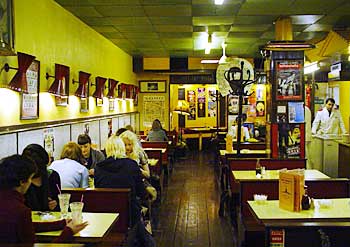
The New Piccadilly café established itself as a popular melody in the songbook of London life for over fifty years. Located just around the corner from the discrete red lights of Soho and blazing neon of Piccadilly, London's most famous café offered its regular patrons cosy warmth on dark wintry days and calm shade away from summer's shimmering heat and dust. 


I count myself lucky. True, I miss the place, being one of a legion of former New Piccadilly regulars who relished those days when the café's friendly waiters, clad in their colonial-style tunics, served us wholesome and satisfying grub. The familiar and friendly atmosphere would wrap itself around us as we sat on our wooden pews at formica tables, illuminated by Festival of Britain lights straight from 1951.


We miss owner Lorenzo Marioni (above), who came to Britain from Italy in 1949 and later took over the business from his father, Pietro. Lorenzo would orchestrate the lunch and tea-time rushes, accompanied by classical music on the wireless. Beside him hissed the New Piccadilly's huge espresso and cappucino-making machine, encased in enamel so pink that it would've brought a blush to Lady Penelope's cheeks.


In its 1950s heyday, the New Piccadilly welcomed Hungarian dissidents, Italians, Greeks, Jews, Maltese and Irish, all tough guys who occasionally threw tea cups and then their fists. In those austere post-war days, the café operated next door to the Casino de Paris strip club. Outside on Denman Street, 'women of the night' plied their trade night and day, often in 'pea soup' fogs. 


Smack bang in the heart of the West End, London's 'Theatreland' luvvies also flocked to the New Piccadilly. When the post-war fog and gloom began to lift in the 1960s, the New Piccadilly attracted a glamorous clientele, including British actress Diana Dors (below), who regularly sipped frothy coffee whilst enjoying the relative anonymity that the café offered.


When I first found refuge in the New Piccadilly in 2004, it seemed to have captured the nostalgic feel and flavour of 1950s and 60s London. Nowadays, the café is a part of my own personal nostalgia*. If only that atmosphere could've been somehow bottled and preserved. Sadly, Lorenzo was forced to close the business in September 2007, forced out by a yearly rent of £51,000 with the business rate and insurance on top. "It's £70,000 before I open the door - and I'm selling cups of tea at 50p," Lorenzo once remarked. 


The New Piccadilly, as London as egg and chips, has since been ripped out of Denman Street. That entire block is now due for a shops and office development, one of those pre-derelict glass and steel plazas boarded up with Starpizza and Express Bucks, devoid of character and tradition. Y'know the kind of place, a consumer void with no soul and no balls where it's hard to believe anything really interesting is thought, spoken or conceived.


Happily, Lorenzo escaped these corporate sorcerors, a cheery postcript to the tale of the New Piccadilly. Some of Lorenzo's former neighbours, shopkeepers on Denman Street, told me recently that Lorenzo is enjoying his well-deserved retirement.  "I'll be off on a yacht to the Caribbean with a blonde on each arm," Lorenzo joked with me days before he flipped the sign on the door to 'Closed' for the final time. 


Even if Lorenzo hasn't sailed off fully laden into a Caribbean sunset, it's good to hear he's finding some peace and joy. It's well deserved. After all, Lorenzo and the lads dished up good food and drink for Londoners over decades - served always with a slice of Soho and a portion of Piccadilly.


(Above): Infuriatingly, on some days, the New Piccadilly closed due to the café's appeal as a ready made film set. For instance, in the The Girl in the Cafe (2005), Bill Nighy plays Lawrence, a lonely civil servant who falls for the enigmatic Gina (Kelly Macdonald). Oi! Bill, Kelly, you're sat at my table! 

* nostalgia = past pain

Dors image: Image Shack

Paul Coleman, London, February 2010